
Transcript
Dr. Turck:
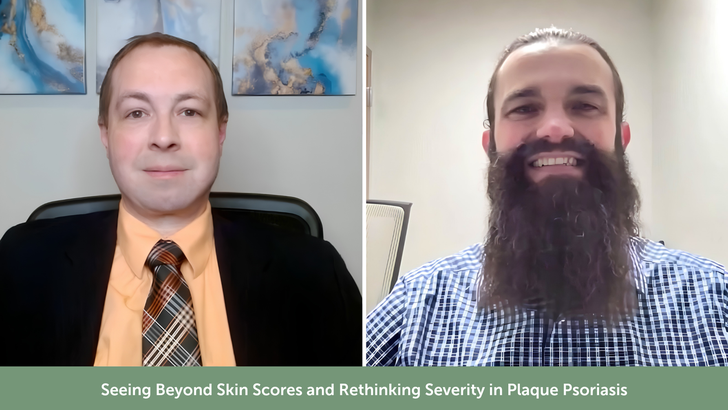
This is DermConsult on ReachMD. I'm Dr. Charles Turck, and today I'm joined by Dr. Steven Daveluy to discuss how we can look beyond skin scores to more comprehensively assess plaque psoriasis severity. He's the Program Director of Dermatology at Wayne State University School of Medicine in Michigan.
Dr. Daveluy, thanks for being here today.
Dr. Daveluy:
Thanks so much for having me and for shining a light on the topic.
Dr. Turck:
Well, to start us off, when we're grading psoriasis severity, BSA and PASI are the tools most of us reach for first. What do those tools actually tell us about a patient's psoriasis, and what are they not designed to capture?
Dr. Daveluy:
Both the BSA and PASI tell us about the physical signs and the things we can see for their psoriasis—the body surface area involved for BSA, and for PASI, it’s the body surface area plus the severity and grading the thickness and the scale, so all things you can actually glean from a picture of a patient. But that means it leaves out the life experience, like the itch, the quality of life, the impact on sleep, and all the other things that patients think about when they're thinking about their psoriasis and how it impacts their life.
Dr. Turck:
Now, when a patient's BSA or PASI is low, how does involvement of a high impact site like the scalp, nails, palms and soles, or genital skin factor into your overall assessment of disease severity?
Dr. Daveluy:
The reason we call them “high-impact sites” is because they really do have a big impact on patients' life. People can't use their hands when they have psoriasis on them, or they might be embarrassed to shake hands. Genitals obviously have life impact implications. And so those things push us toward more aggressive treatment and control of the psoriasis because even though the BSA may be low, those are really important areas that really impact patients a lot.
Dr. Turck:
And when a patient reports significant itch, pain, or sleep disruption, but their skin looks fairly controlled on exam, what does that tell you about how active their disease actually is?
Dr. Daveluy:
That's a really important thing for dermatologists to ask their patients about—the symptoms, the sleep, the itch disturbances—because sometimes they look okay, but the patient is still suffering. And if we just look visually, we will say, "Okay, you're doing great. Come back and see me in six months." And occasionally, it could even mean there's something else going on that we need to explore. Psoriasis patients can still have eczema or allergic contact dermatitis.
Dr. Turck:
If we look beyond symptom burden alone, how do the broader quality-of-life impacts measured by DLQI factor into your assessment of a patient's disease severity?
Dr. Daveluy:
My goal is always to give patients a life where they don't have to think about their psoriasis, and that's where quality of life really comes into play. You can use tools like the DLQI, which is very useful in collecting, documenting, measuring, and making sure that you're getting that quality-of-life impact under control.
But I also just keep it as simple as saying, "What are you going to do when your psoriasis is under control that you can't do now?" And it speaks to that same idea, and it gives us a new target for our treatment— that we want to get the patient there. And it's nice because it involves the patient. It makes sure that you understand how their psoriasis impacts their life and then work toward a treatment plan that eliminates that impact so they can almost forget they have psoriasis.
A patient we saw recently who, when we first saw the patient, had severe psoriasis, had about 13 percent body surface area and a lot of itch and was losing sleep over it. His wife came with him to the appointment and was also very eager for us to get the psoriasis under control, both for him to have a better quality of life and for her. He had a ton of progress at the three-month mark. He was clearing up really quickly, nearly clear. So we stayed the course, and at the six-month mark when he came back, his skin looked amazing. He had some macular erythema but no more scale. It was a very small body surface area involved. So at first look, we thought, "All right. We did it. We reached our goal. You're doing great."
But luckily, we asked that important question of, "Okay, your psoriasis looks great. Is it still impacting your life in any way?" And he opened the floodgates and said, "Yes. The itch is still really severe. Even though my skin looks a lot better, the flaking's gone down, and the plaques have flattened out, I'm still getting a lot of itching in those areas, and it's still disrupting my sleep." And we all know when your sleep is disrupted, everything is dysfunctional. His marriage was struggling because of it. He was struggling at work and at home to focus and to get things done.
And had we not asked that question of that impact on quality of life, we would've just looked at him and said, "Oh, you look great. You're technically at your treatment target goal, less than one percent body surface area involved." I just think about the fact that if we hadn't asked that question and we'd only looked at his skin, we wouldn't have opened that door to know that he was still suffering a lot with the itch and the disrupted sleep.
Dr. Turck:
For those just joining us, this is DermConsult on ReachMD. I'm Dr. Charles Turck, and I'm speaking with Dr. Steven Daveluy about factors to consider when assessing plaque psoriasis severity.
Now, when you consider BSA and PASI alongside special area involvement, symptom burden, and quality of life impacts, how does that fuller picture help you identify unmet needs for your patients?
Dr. Daveluy:
I think all of those elements are really important. And if we miss one, we may not give patients the level of control of their psoriasis that they really deserve. If we're focusing solely on what we see with the BSA or the PASI score, we might not know those other impacts on their life. And then the patient doesn't get that level of disease control that really every psoriasis patient should have now.
Our treat-to-target goal is one percent BSA or less, which, again, focuses on the BSA. But really, as I mentioned earlier, I want to give patients freedom from their psoriasis so it doesn't impact their life and they don't have to think about it every day.
Dr. Turck:
And as we wrap up for today, Dr. Daveluy, what key takeaways do you want to share with clinicians when it comes to more comprehensively assessing plaque psoriasis severity?
Dr. Daveluy:
I would say our first instinct is to always look at the psoriasis, look at the body surface area involved, and make a quick judgment. But don't forget that it's really important to ask patients about the itch, the sleep quality, and the impact on quality of life, because those are the things we can't see, and only the patient can tell us about them. But they're really important for making sure that the disease is not controlling their life and making their life more difficult.
Dr. Turck:
Great comment for us to think on as we come to the end of today's program. And I want to thank my guest, Dr. Steven Daveluy, for joining me to discuss how we can look beyond skin scores to assess the severity of plaque psoriasis.
Dr. Daveluy, it was great having you on the program.
Dr. Daveluy:
Thanks very much for having me. It was great being here.
Dr. Turck:
For ReachMD, I'm Dr. Charles Turck. To access this and other episodes in our series, visit DermConsult on ReachMD.com, where you can Be Part of the Knowledge. Thanks for listening.

